Showing posts with label history. Show all posts

Monday, April 04, 2022

The Last Duel (2021)


First impression sucked. 

The first impression and truly worst, ironically, is the star studded cast: Matt Damon, Ben Affleck, and Adam Driver, playing Jean de Carrouges, Pierre d’Alençon, and Jacques Le Gris respectively.

Thursday, October 07, 2021

Heretic (The Grail Quest)

Heretic is thematically in-step with the name of the series – the Grail Quest – but is it a case of too little too late? The Grail Quest is a 4 book series, Heretic is the 3rd; although I am not sure if the supposed last book, 1356, is a natural book 4 because some google searches only had the Quest up to 3 books. Maybe Cornwell saw Heretic extremely lacking and made a 4th book.

Thomas of Hookton got himself out of Edward III’s French Campaign. He’s not a deserter; he formally embarks on a quest for the grail, accompanied by Sir Guillaume, Robbie Douglas, and a small contingent of archers and men-at-arms from the King’s army. After 2 books of being a tourist in Edward III’s part of the Hundred Years War we finally focus on the grail.

Monday, September 27, 2021

Fukushima 50 (2020)

Tsunami was 43-46 feet high

 
It was one of those what-am-I-going-to-watch moments that I came upon Chernobyl among my files. But I've seen that, so I wondered if there is a series or movie about the Fukushima Daiichi Nuclear Plant? That's how I came by Fukushima 50, the only movie that came up in a google search. 

According to legend, 50 plant workers remained to save the nuclear plant and the rest were evacuated. In reality, there were more than 50 workers as back up from all over country was already on site, but the zeitgeist had already favored the number 50.

Thursday, June 03, 2021

Vagabond (The Grail Quest)

Without a doubt Bernard Cornwell can write battle scenes with great detail, but in Vagabond, book 2 of the Grail Quest, I feel there’s too much of it. Two great battles serve as bookends. Come to think of it, in Harlequin there are also two, so why did I enjoy that book more than this one?

For one, that first battle in the book 1 of the Grail Quest was a siege. As a siege there is no big inferno that would block out any character movement or growth. Soldiers wait in a siege for months; occasionally they would attack just to see if the wall is still standing.

That siege happened just a little after the massacre in Hookton which drove Thomas to sign up for the English army invading France. Story wise, I can pick Thomas out from the crowd as they say.

He was an up and coming star in the Army under Will Skeat, so as a reader you are caught up in only his growth. One by one he bumps into men of title leading the siege until eventually his plan rises on top, eventually used to winning the La Roche-Derrien. The walls of the La Roche-Derrien surrounded by the English army are only second in importance. 


In Vagabond, emotional as battles can be, the narrative emotion stops. I’m not as emotionally aware where Thomas is if I care at all.

Battles are about the field, the formation, what types or soldiers are placed where, the movement. There’s also the ebb and flow, sometimes one side looks like it is winning, and then after adjustment the other side is able to fight back. Always the appreciation of the battle is the bigger picture, keeping that map in mind. Point is, as far as story telling is concerned, I have been jarred out of Thomas’ headspace. Battles are not about individuals.

I think Cornwell approached the Grail Quest as a tour of the entire campaign of King Edward III against France, from the fields of Brittany to Calais to the borders of Scotland, with Thomas the Archer as the tourist.

It can be argued that at the forefront of the story is the super soldier of the times, the archer, and with it the social upheavals between classes: the moneyed armored knights and the everyday man who can pick up a longbow. Following the story of the English archer – not just Thomas – is the fate of two countries in England and France who are the epitome of the battling war philosophies: archers versus knights.

The Grail, which what this series is named after, and the mysterious Vexille family who have long been connected with the legends of the Grail, come in ironically at a distant third.

Hell, even at book 2, Thomas is still confused or not that interested with finding, for lack of a better term, his family heirloom. He is as I said a tourist pulled into many theaters in this Edward IIIs so far triumphant stint in the Hundred Years War. So, on that point, at least from the point of expectation Book 2 is a disappointment.

The atmosphere of the Holy Grail needs more religion and mystery than he’s setting up. It could be a bad case of marketing or a poor choice of a macguffin. Bernard Cornwell description of the political and military situation is just that great. Having read only my second series of him – Warlord Chronicles being the first – politics and the army seems to be more his forte.

Wednesday, May 05, 2021

Harlequin (The Grail Quest)

Harlequin or to the US market The Archer’s Tale is the story of Thomas, a young man of a quiet seaside town of Hookton, England. The town fell to French raiders and among those killed was his father. So young men do what is expected, they vow revenge.

Problem is he has no idea who the raider was aside from the fact they were French and he managed to note a coat of arms among them. But in the 14th century with no benefit of a Google Lens search the task ahead was still insurmountable especially on foreign soil. So the next best thing that Thomas can do is kill any Frenchman. He signs up with the English army to join a war in France as an Archer.

Plot wise this is where the story may feel stalled. The book opened up with a desire for revenge but the Hookton raid and the coat of arms was sparingly talked about if at all for maybe half the book. This is only my second series written by Bernard Cornwell, my first was the Warlord Chronicles; I’m hanging on faith that his first books are detailed setups. The action comes in the second book.

For most of this book Thomas is reacting to his orders, after all he fights for the King of England. And he cannot just pack up to go on a private revenge tour in a foreign country. So instead of revenge Harlequin becomes more an account of 14th century warfare.

There is the army composition meaning there isn’t an army in the modern sense; professional soldiers under one ministry under the head of state, which in the 14th century is the King. It seems like the King has his rich Lords do many of the hiring. If there was regular pay I cannot remember, but if the army won they’re allowed to loot the city of treasures including the rape its local women.
 
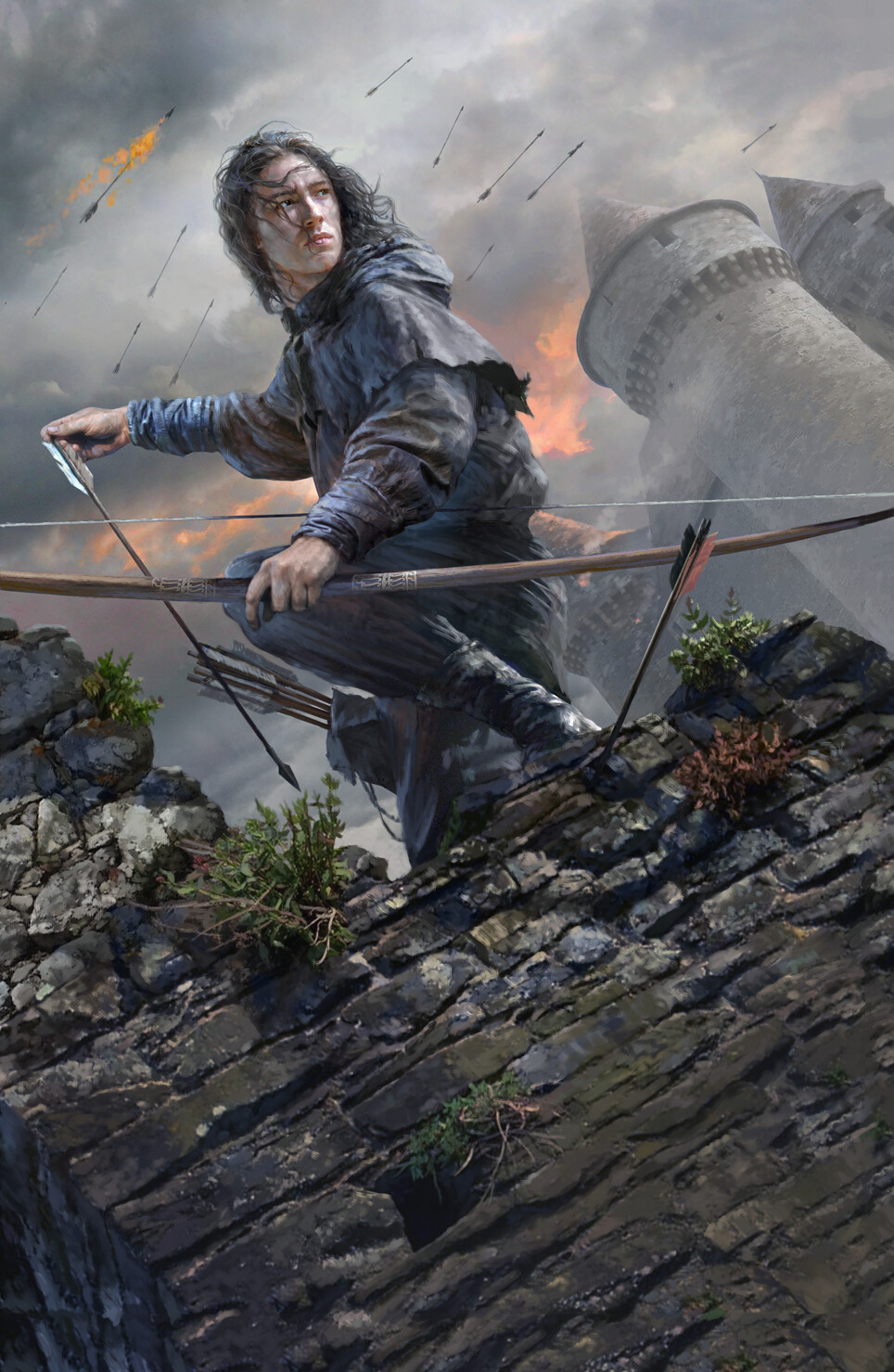
art by Sergey Shikin


There is also the issue of class status in the army. Thomas is an archer which is an upstart class. The armored knight fall into the romance and tradition, and wealth: armor costs money, longbows not as much. Disagreements between these classes of soldiers point further the irregular nature of the 14th century army.

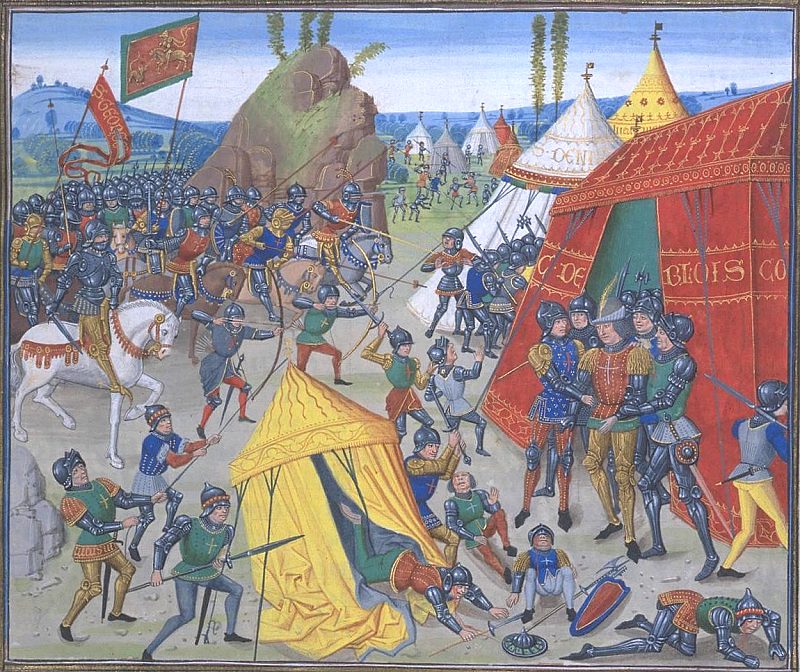
Like the Warlord Chronicles, Cornwell can write you a detailed play by play from all sections of a battle line. The story is filled with battles and the sacking of the town, city, or castle afterwards. Peaceful moments are just the preparation to the next battle. The Battle of Crécy feels like it’s a quarter to half a book when I read it from preparation to every troupe movement to its ending.

As far as detail and the beauty of the writing as far as war is concerned, I’d say Cornwell has successfully put me in the mind of Thomas as I am always thinking of the French country side and the next battle. The detail was so real and specific that when the Holy Grail was mentioned it feels out of place amid the muck of 14th century warfare. I am almost as annoyed of the Holy Grail is and for exactly the same reason as Thomas.

Is it a negative on Bernard Cornwell’s part that I am not interested in the Grail after Harlequin? But I am interested in seeing justice for Hookton. Onward to Vagabond.

View all my reviews

Sunday, April 11, 2021

Excalibur (The Warlord Chronicles)

Excalibur (The Warlord Chronicles, #3)
My rating: 5 of 5 stars

I always come back to the magic, and like in the previous two books I don’t know where I want to be. We can have a world where magicians levitate at will, shoot energy blasts, shape change, teleport, or none of it, just to keep this a grounded medieval adventure. The previous two struck a difficult balance between actual magic, dumb luck, and men who know a bit of science and present them as magic.

Enemy of God (The Warlord Chronicles)

Enemy of God (The Warlord Chronicles, #2)
My rating: 5 of 5 stars

I like this, book 2 of the Warlord Chronicles, Enemy of God, better than the first. Reason one is that everything has already been setup in part one and now the story can go into action as they say. Lancelot, Merlin, and Galahad are firmly set that all the story could do is begin its steady march towards the inevitable.

The Winter King (The Warlord Chronicles)

The Winter King (The Warlord Chronicles #1)
My rating: 4 of 5 stars

The Winter King reads like the narrative presents itself to be, a personal take by one of Arthur’s warriors.

There are parts when you feel like it’s messy and long, such as getting taxes and telling the story of a battle from a perspective right along the shield wall. Names of places like Dumnonia and Powys, or a king like Gorfyddyd doesn’t help in the marketing, or not even my own memory as I struggle to recall half the names and places in the story. Camelot and Excalibur have different names too which I now fail to recall. But I have to admit it makes it more real, like a history book.

Wednesday, July 22, 2020

Restoration Home (BBC Two)

Dr. Kate Williams, Caroline Quentin and Kieran Long
BBC Two

While on a self declared break from my regular series I went down the rabbit hole that was YouTube, one video led to another until I found myself hooked on Restoration Home.

A production by the BBC Two, the documentary series presents old buildings acquired by ordinary citizens who are willing to see through the crazy idea of restoring said structures to habitability. 

Saturday, December 29, 2018

Goodbye, Darkness: A Memoir of the Pacific War

Goodbye, Darkness: A Memoir of the Pacific War

My rating: 4 of 5 stars

Think of the movie Saving Private Ryan but only if Private James Ryan did most of the talking. If he started his story from his signing up for military service and he talks of his experience from battle to battle; the friends and comrades he had lost, often violently; till finally he talks of his experience again only this time as an old man visiting the old battlefields.

Sunday, December 24, 2017

Silent Night Signals a Fight - Spotlight


Legend has it that Silent Night stopped a war, at least for a night, a hundred years ago in the trenches of the First World War. 

Accounts may differ now on what exactly caused the ceasefire, what songs were sung, what things were done such as was there a game of football? Nevertheless the Christmas truce is remembered as a miracle.

Sunday, November 05, 2017

Saturday, August 19, 2017

The Lost City of Z (2016)


(Spoilers)


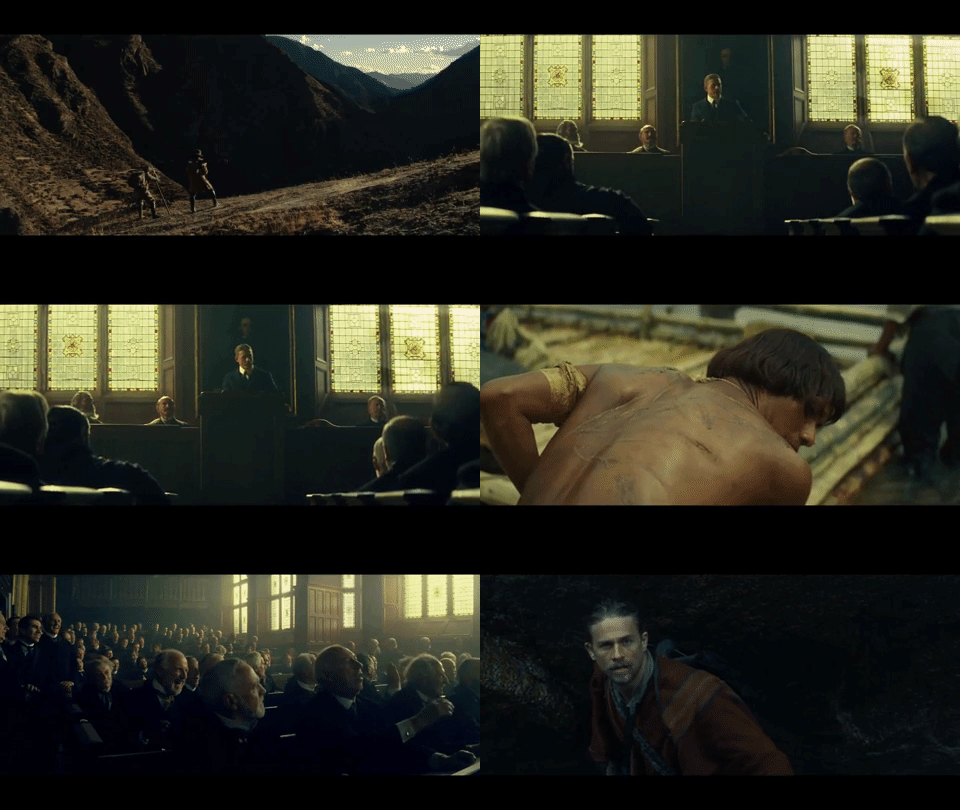
Sounds like a sequel to a Brad Pitt movie but looked more like an Indiana Jones, if Indy was real. The Lost City of Z involves the search of a lost city but with less fun, more public ridicule, long walks and boat rides across vast jungles, and most of all, glory is uncertain.

Tuesday, August 01, 2017

Dunkirk (2017)


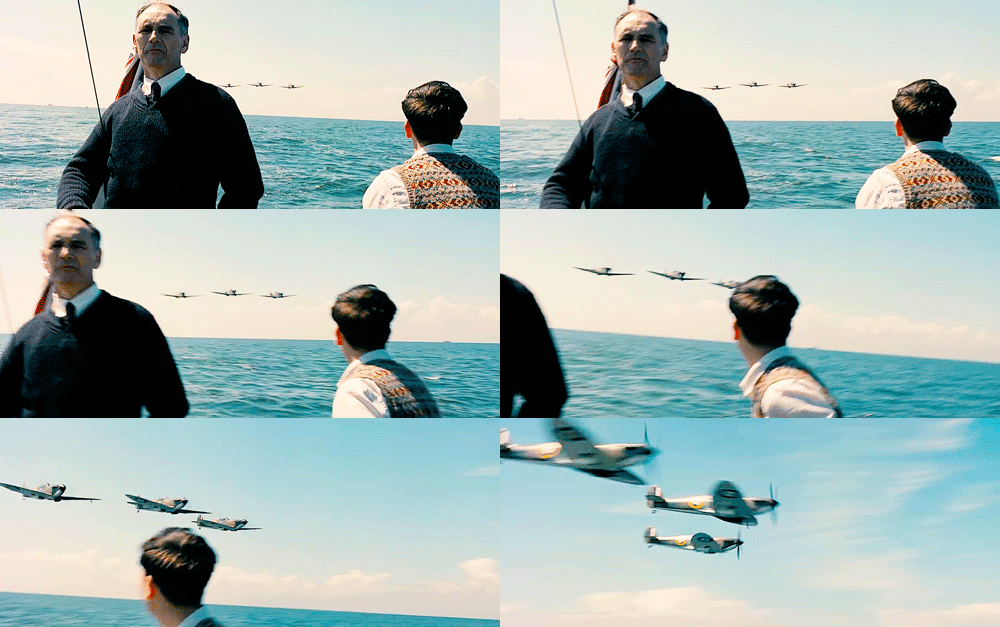
Dunkirk reminds me of 2001: A Space Odyssey – at least what little I remember of it – but with less classical music. Both are critical favorites but there is just an empty feeling when the characters barely talk. Well, empty is a strong word but more a feeling that something is missing.

Tuesday, July 04, 2017

The Lennon Report (2016)


When a loved one dies it’s usually an ordinary day. There’s no sign of it coming and yet it did. You expect the world to end if only because it doesn’t feel right going on without them, yet the world moves on.

Saturday, March 04, 2017

Hirohito: Emperor of Japan

Hirohito: Emperor of Japan

My rating: 4 of 5 stars

I was watching the Netflix series The Crown around the time I was reading this, and all I can think of the book was cliché. Not because there are similar themes running through the stories of the British throne and this Japanese one, and there is. But mainly because it feels untrue, copied; that it’s not fact when Hirohito: Emperor of Japan, especially, as biography it should be.

The common thread in those two which is more apparent in Hirohito: Emperor of Japan is that the throne is a prison as much as it is a position with which to rule. As one who has never occupied a position that can barely command the loyalty of 5, and also one whose country was ravaged by Japan during the Second World War it feels untrue. The head of an empire makes things possible; he’s no one’s prisoner.

Friday, March 06, 2009

Defiance (2008)


Defiance is a story about the struggle of Jews from Belorussia. Hunted like animals they retreated to the forests in order that they live as men. There, even far from the people that hates them; it proved no easy task to maintain the humanity day after day.

Saturday, February 21, 2009

Valkyrie (2008)


In the later years of World War II members in Hitler’s own army were attempting to kill him, and the most famous of these, because it almost succeeded, was the July 20 Plot: the inspiration for the latest Tom Cruise starrer, Valkyrie.

Saturday, February 14, 2009

W. (2008)


Watching W. was distracting to say the least. All the time I was thinking, this is a movie full of impersonators, good and bad. Which is not to say that they were bad actors, it’s just that I never had the ‘suspension of disbelief’ as they say in watching the film. There are physical limitations to looking and sounding like some else it would seem.

Sunday, November 02, 2008

Gettysburg (1993)


I think of Gettysburg, a made for TV movie, as the things learned from ROTC during its heyday. Why keep soldiers in neat formation in an era of muskets and cannons? The result was more than 50,000 Americans dead, making the Battle of Gettysburg the bloodiest in the American Civil War. This was 1863 and it would be two more years before the war was over.